Okay, so you've probably heard the term "design thinking" floating around lately. Maybe you rolled your eyes. I get it—it sounds like corporate buzzword bingo.
But hear me out. I've fallen in love with this mindset, and I think you will too.
⬛ So, What's the Big Deal?
For me, design thinking boils down to one simple habit:
Asking better questions.
I constantly catch myself thinking: "What problem am I actually trying to solve today? And is it even worth solving?
Then I go deeper: What do I truly value? Am I making a real difference—for myself, my family, my clients, the world?
Heavy stuff, I know. But it's changed the way I work and live.
⬛ Let Me Give You a Real Example
A client once came to me with a beautiful shirt that was too tight across the back. They asked me to "let it out." Simple, right?
But instead of grabbing my scissors, I asked: "When does this bother you most?" They said: "When I'm driving to work."
Suddenly, the problem wasn't the shirt—it was their driving posture and the fabric's lack of stretch. I added a small hidden gusset under the arm and tweaked the shoulder slope. Problem solved. They didn't just get a looser shirt; they got a shirt that actually worked for *their life*.
That's design thinking. No whiteboard required.
⬛ How Tailors Can Use It (In 5 Simple Steps)
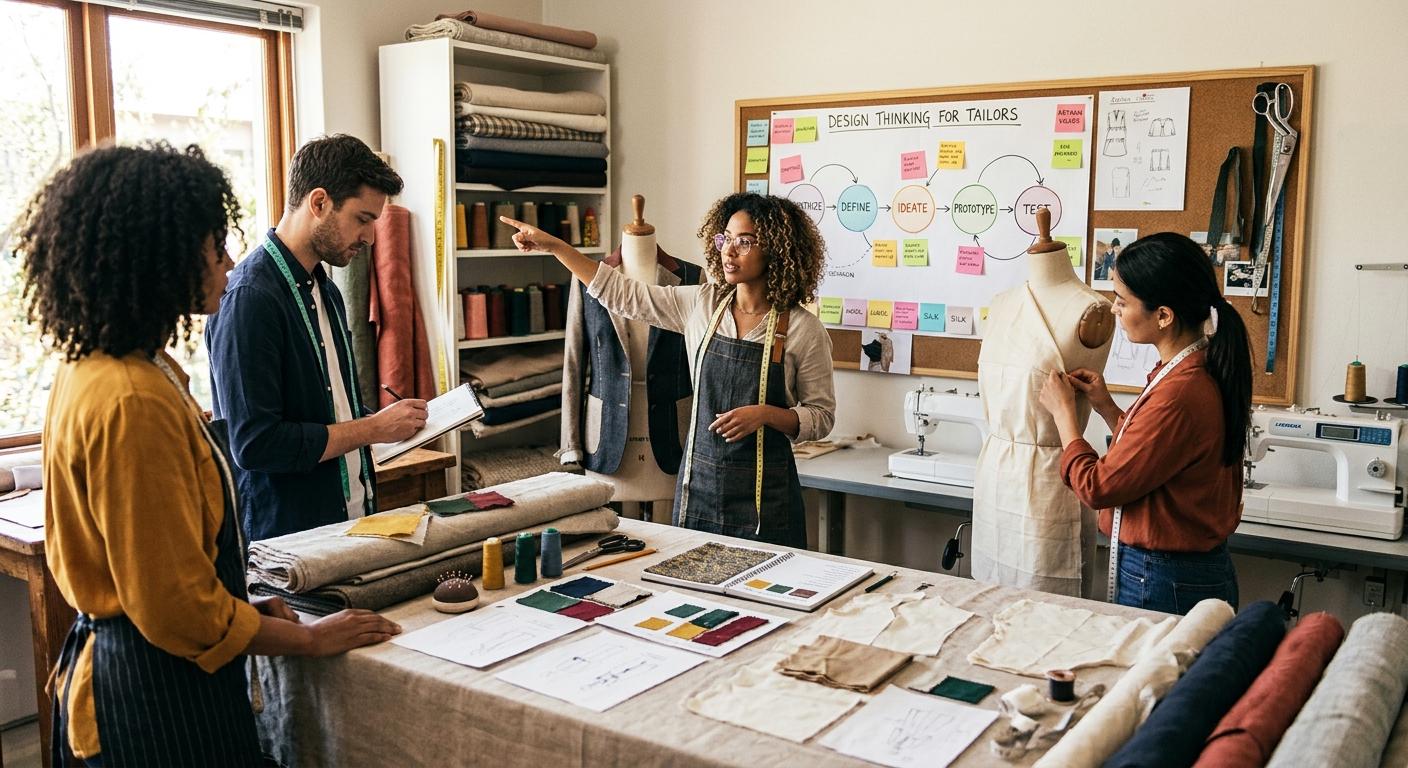
Here's the 5-step process, translated from "tech speak" to "tailor speak":
Step | What It Means for You:
1- Empathize | Really listen to your client—their habits, their insecurities, their lifestyle. Not just their measurements.
2- Define | Figure out the *real* issue. Not "hem is too long," but "they need to feel confident in meetings."
3- Ideate | Sketch a few different approaches. Don't just go with your default. Brainstorm!
4- Prototype | Make a quick muslin/toile first. Test before you cut that expensive fabric.
5- Test | Hold a fitting. Get feedback. Tweak. Repeat until it's perfect for *them*.
Simple, right?
⬛ Why This Matters (Especially for Us)
Here's what I've noticed since I started thinking this way:
- I waste less fabric. Prototyping saves me from costly mistakes. - My clients trust me more. They feel heard, not just measured. - I sleep better at night. I'm making clothes that actually matter to people, not just churning out alterations.
And honestly? It's made me feel more connected to my craft. I'm not just a tailor anymore—I'm a problem-solver, a confidence-builder, and sometimes even a therapist (in the best way).
Your Turn
You don't need a fancy degree or a startup to try this. You just need curiosity.
So here's my challenge to you:
Next time a client sits down with you, ask them one extra question:
*"What's one thing you wish your clothes could do for you that they don't right now?"*
Their answer might surprise you. And it'll definitely change how you sew.
Give it a shot this week and let me know how it goes! I'd love to hear your stories in the comments.
■ One Last Thought
At the end of the day, design thinking isn't about being trendy. It's about remembering why we picked up a needle and thread in the first place: to make people feel good, to create something beautiful, and to leave the world a little better than we found it.
And honestly? That's a problem worth solving.
What problem are *you* trying to solve today? Drop a comment—I read every single one. :)
👉 💌 Join our Email Newsletter 💌 👈