
This guide is based on practical sewing knowledge and general needle-selection guidelines. It has been written and edited by the author to help sewists choose a suitable sewing machine needle for different fabrics and sewing projects .A sewing machine needle may look like a very small part of your sewing setup, but choosing the right one can make a surprisingly big difference.If your machine is skipping stitches, damaging the fabric, breaking thread, or making unusual holes, the needle may be the first thing you should check.Different fabrics require different types and sizes of needles. A needle that works perfectly on lightweight cotton may not be suitable for denim or stretch fabric.So, how do you know which needle to use?Let's make it simple.
What Do the Numbers on a Needle Mean?
Sewing machine needles are usually labeled with numbers such as 60/8, 70/10, 80/12, 90/14, or 100/16.The number generally indicates the needle size. The higher the number, the thicker the needle.A useful starting point is:
- 60/8: Very lightweight fabrics
- 70/10: Lightweight fabrics
- 80/12: Light to medium-weight fabrics
- 90/14: Medium to heavier fabrics
- 100/16: Heavy fabrics
These are general guidelines rather than strict rules. The appropriate size can also depend on the thread, fabric construction, and specific sewing machine.The goal is to choose a needle that is strong enough to penetrate the fabric without creating unnecessarily large holes.
Universal Needles: A Good Starting Point
Universal needles are one of the most versatile choices for everyday sewing.They have a slightly rounded point and can be used for many common woven fabrics and some general sewing projects.Good for:
- Cotton
- Linen
- Polyester woven fabrics
- Poplin
- Lightweight wool
- General sewing projects
For lightweight fabrics, try a smaller size such as 70/10. For medium-weight fabrics, 80/12 or 90/14 may be more appropriate.
Ballpoint Needles for Knits
Knit fabrics need a different approach because their structure is made from loops rather than the same type of woven construction found in many woven fabrics.A ballpoint needle has a rounded tip designed to move between the fibers or loops rather than cutting through them as sharply as a regular sharp needle.Good for:
- Jersey
- Lightweight knits
- Interlock
- Some sweater knits
- Other knitted fabrics
A 70/10, 80/12, or 90/14 may be suitable depending on the weight of the fabric.If your knit fabric is stretching during sewing or you are experiencing skipped stitches, choosing a needle specifically designed for knits is worth trying.
Stretch Needles for Elastic and Stretch Fabrics
Stretch needles are designed specifically for highly elastic fabrics and materials containing elastane or spandex.They have a specially designed point and are useful when a ballpoint needle isn't giving you the results you need.Good for:
- Stretch jersey
- Lycra
- Spandex blends
- Swimwear fabrics
- Highly elastic garments
A 75/11 is a common starting size for many stretch fabrics, although the appropriate size depends on the fabric weight.When sewing stretchy garments, the needle is only one part of the equation. Thread, stitch type, presser foot, and machine settings can also affect the final result.
Microtex Needles for Fine and Delicate Fabrics
Microtex needles have a very sharp, slim point designed to create precise penetrations.They can be particularly useful for fabrics that require a clean needle penetration.Good for:
- Silk
- Microfiber
- Lightweight tightly woven fabrics
- Fine synthetic fabrics
- Some delicate woven fabrics
For very lightweight fabrics, a smaller size such as 60/8 or 70/10 may be appropriate.Always test the needle on a fabric scrap first, especially when working with expensive or delicate material.
Denim and Jeans Needles for Heavy Fabrics
When sewing denim, canvas, or other heavy materials, a regular lightweight needle may bend or break.Denim/Jeans needles are designed with a stronger shaft and are intended for penetrating heavier woven fabrics.Good for:
- Denim
- Heavy cotton
- Canvas
- Workwear fabrics
- Multiple layers of heavy woven fabric
Common sizes include 90/14 and 100/16, depending on the thickness of the material and number of layers.If you're sewing through several layers, don't simply choose the largest needle available. The needle should still be appropriate for the thread and fabric.
Leather Needles for Leather and Similar Materials
Leather requires a specialized needle because it cannot be treated like ordinary woven fabric.Leather needles have a cutting point designed to penetrate leather and similar materials.Good for:
- Genuine leather
- Some faux leather
- Vinyl
- Other dense, leather-like materials
The exact needle size depends heavily on the thickness of the material.Keep in mind that leather also behaves differently from fabric because needle holes are permanent. Always test on a scrap before sewing the actual garment or project.
What Happens When You Use the Wrong Needle?
Sometimes the needle problem is easy to recognize.You may notice:
- Skipped stitches
- Broken thread
- Broken needles
- Fabric damage
- Large or uneven needle holes
- Puckering
- Unusual machine noise
If something suddenly goes wrong, don't immediately adjust the tension or change several machine settings.Start with the basics:Check the needle.Is it the correct type? Is it the right size? Is it bent or dull? Is it installed correctly?Replacing the needle is often one of the simplest troubleshooting steps.
When Should You Change Your Needle?
A needle doesn't need to be visibly broken before it needs replacing.With use, needles become dull or damaged, and this can affect stitch quality.It's a good habit to start a new project with a fresh needle, especially when:
- Changing to a different type of fabric
- Starting an important garment
- Working with a delicate fabric
- Sewing for an extended period
- The needle has hit a pin or another hard object
If a needle bends or hits something hard, replace it rather than continuing to sew with it.
Don't Forget the Thread
Needle selection and thread selection work together.A very fine needle paired with a very thick thread can create problems, while a heavy needle and very fine thread may not produce the result you want.As a general rule, finer fabrics usually need finer needles and finer thread, while heavier fabrics can accommodate heavier combinations.Always consider the entire sewing setup rather than choosing a needle based only on fabric type.
A Simple Needle Guide
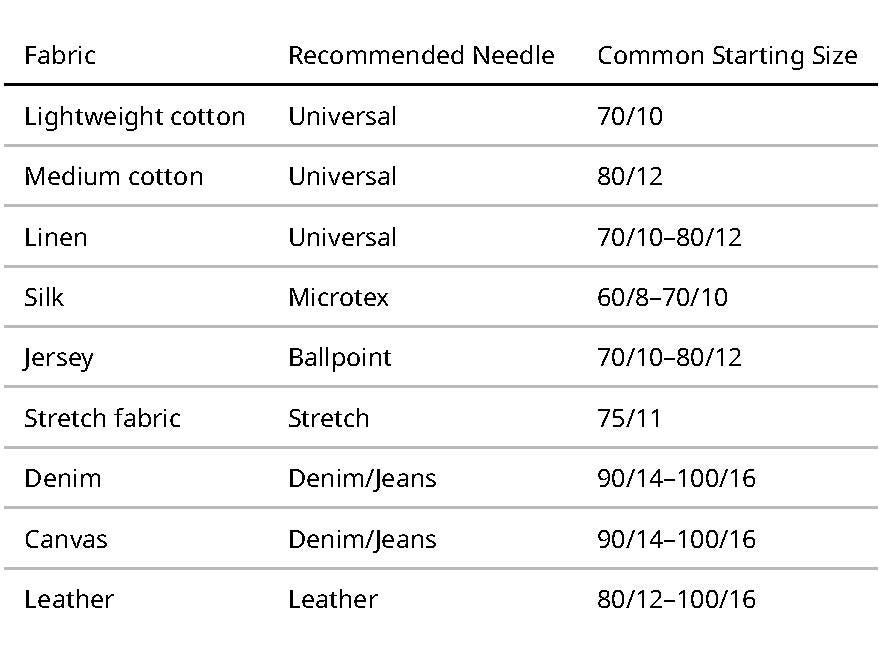
These sizes are starting points, not absolute rules. Always test the needle, thread, and fabric combination on a scrap before beginning the final garment.
Final Thoughts
Choosing a sewing machine needle doesn't have to be complicated.Start by looking at the fabric type, fabric weight, and whether it stretches. Then choose a needle designed for that material and select a size appropriate for its weight.If your stitches don't look right, don't overlook the needle. Sometimes a small change can solve a surprisingly frustrating sewing problem.And perhaps the most useful habit of all: keep a variety of needles in your sewing room and label them clearly. When you know what each needle is designed for, choosing the right one becomes part of your normal sewing routine rather than another mystery waiting to be solved.A good needle is small, inexpensive, and easy to overlook. But when it is the right one, your machine will definitely notice.